
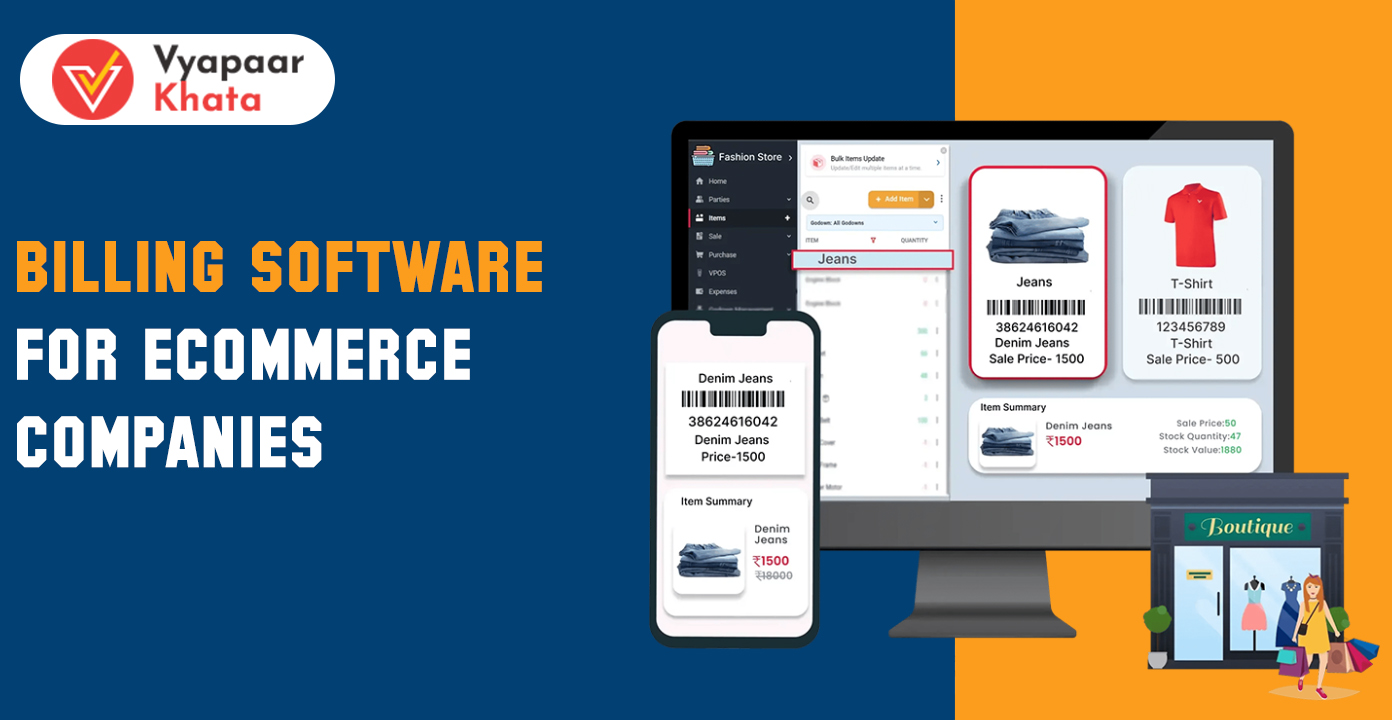
Ecommerce billing software is a specialized digital system that automates the creation of invoices, manages online orders, tracks taxes such as GST, syncs inventory, and connects with payment gateways and shipping partners. Unlike traditional billing tools, it is built specifically for high-volume online transactions and multi-channel order flows.
Why Ecommerce Businesses Need Specialized Billing Solutions
Modern ecommerce brands sell across multiple platforms—Amazon, Flipkart, Meesho, Shopify, websites, and social commerce. Handling invoices, payments, returns, and tax calculations manually leads to errors and delays. Specialized billing software ensures every order automatically converts into a compliant invoice, updates stock in real-time, assigns shipping labels, and syncs payment information for smooth operations.
Importance of Automation in High-Volume Online Sales
Online sellers often handle hundreds or thousands of daily orders. Automation helps by:
- Generating GST invoices instantly
- Auto-updating stock after every sale
- Syncing delivered/returned status
- Connecting to shipping APIs for faster dispatch
- Minimizing human error in high-speed workflows
Automation not only saves time and manpower but also improves accuracy and speeds up order fulfillment—critical for platforms with strict SLA requirements.
Key Challenges in Ecommerce Billing
Ecommerce companies face a unique set of operational and compliance challenges:
- Inventory Sync: Stock must update automatically across all channels to prevent overselling or cancellations.
- GST Compliance: Automated HSN codes, tax slabs, and e-invoice/e-way bill support are essential.
- Multi-Channel Orders: Managing orders from multiple marketplaces and websites in one dashboard.
- Returns & Refunds: Auto-credit, inventory adjustments, and reconciliation after order returns or RTO (Return to Origin).
A good ecommerce billing software solves these pain points by centralizing all billing and operational processes.
What Is Billing Software for Ecommerce Companies?
Billing software for ecommerce companies is a tool that automatically generates invoices, manages orders, processes taxes, updates stock, and syncs with marketplaces and courier partners — all from one dashboard.
Technical Definition
A cloud-based integrated billing and order management system capable of fetching API-based marketplace orders, generating GST-compliant invoices, pushing real-time inventory updates, reconciling payments, handling COD/prepaid transactions, and automating tax reporting.
Difference Between Normal Billing Software and Ecommerce-Focused Billing Software
| Feature | Normal Billing Software | Ecommerce Billing Software |
|---|---|---|
| Order Source | Mostly offline/in-store | Multi-channel marketplaces + website |
| Inventory | Manual updates | Auto-sync across platforms |
| Automation | Limited | High-level automation (API-driven) |
| Shipping | No courier integration | Direct integration with logistics providers |
| GST | Basic tax support | Full GST, HSN, e-invoice, e-way bill automation |
| Reconciliation | Manual | Auto reconciliation with marketplaces/payments |
Core Components of Ecommerce Billing Software
- Invoicing Engine: Auto GST invoices for every order.
- GST & Tax Module: HSN codes, GST slabs, credit notes, e-invoicing, e-way bills.
- Payment Gateway Sync: Matches online payments, detects pending/failed transactions.
- Shipping Integration: Generates labels, assigns couriers, tracks shipments.
- Order Management System (OMS): Centralized dashboard for managing all marketplaces and website orders.
- Inventory Sync: Live stock updates across Amazon, Flipkart, Shopify, WooCommerce, etc.
- Returns & Refunds Handling: Auto credit note generation and stock adjustments.
Why Ecommerce Companies Need Billing Software
Multi-Channel Order Handling
Ecommerce businesses sell on:
- Dial4trade.com
- Amazon
- Flipkart
- Shopify
- WooCommerce
- Meesho
- Ajio
- Myntra (for brand sellers)
- Own websites/apps
Billing software pulls all orders into a single dashboard, creates invoices automatically, and eliminates manual data entry.
Automated GST Invoices for Online Orders
Every marketplace requires sellers to generate GST-compliant invoices. Automation ensures:
- Correct HSN codes
- Proper GST slab calculations
- Instant e-invoice or e-way bill generation (if applicable)
- Auto credit-note creation for returns
Managing COD vs Prepaid Orders
COD orders need:
- Cash tracking
- Reconciliation with courier partners
- Recording collection delays or failed deliveries
Prepaid orders need:
- Payment gateway settlement tracking
- Refund automation
Billing software simplifies both.
Syncing ERP, Billing, Inventory & Warehouse Systems
With APIs and integrations, ecommerce-focused billing tools ensure:
- Real-time stock movement between warehouses
- Automated purchase-to-sale tracking
- Batch/lot management (for FMCG, cosmetics, pharma, FMCG)
- Accurate stock levels across marketplaces
This prevents stock mismatch penalties from platforms.
Faster Reconciliation with Marketplaces
Marketplace payments (Amazon/Flipkart) come with fees, commissions, shipping charges, and settlements.
Billing software helps sellers:
- Match invoices with settlements
- Track missing payments
- Identify fee overcharges
- Prevent financial leakage
Key Features of Ecommerce Billing Software
GST-Compliant Invoicing
The software automatically generates GST invoices with correct HSN codes, tax slabs, invoice series, and e-invoice/e-way bill support. It eliminates manual tax calculation and ensures 100% compliance with government rules.
Multi-Channel Order Import (Amazon/Flipkart/Shopify APIs)
Ecommerce billing software connects via APIs with marketplaces like Amazon, Flipkart, Meesho, Ajio, and online stores like Shopify, WooCommerce, Magento. Orders are fetched in real time into a single dashboard.
Automated Inventory Updates
Whenever an order is placed, shipped, delivered, or returned, the software auto-updates stock across all selling channels—preventing overselling, stock mismatch, and penalties from marketplaces.
Shipping & Logistics Integration (Delhivery, Bluedart, ShipRocket)
The system integrates directly with courier partners such as Delhivery, Bluedart, Ecom Express, Xpressbees, and aggregators like ShipRocket. It helps generate AWB labels, select couriers, track shipments, and automate dispatch workflows.
Order Tracking & Cancellations
Every order’s status—Packed, Shipped, Delivered, Returned, RTO—is tracked automatically. Cancellation requests from marketplaces are synced and updated without manual intervention.
Credit Notes & Return Management
When returns or RTO cases occur, the software auto-creates credit notes, adjusts stock, and updates GST reports. This is essential for industries with high return ratios.
Payment Gateway Reconciliation
The system matches order payments with settlements from Razorpay, PayU, Cashfree, Stripe, and marketplace payments. It identifies missing settlements, fee mismatches, and COD pending collections.
Bulk Invoice Generation
Sellers handling 500–2000+ orders daily can generate invoices in bulk with one click, improving dispatch speed during peak sale seasons.
SKU-Wise Sales Reporting
The software provides deep analytics:
- SKU-wise sales performance
- Top-selling products
- Profitability reports
- Channel-wise revenue breakdown
This helps identify high-performing categories and plan inventory accordingly.
User Roles & Security
Admins can control user access—billing, warehouse, finance, reconciliation. Advanced features include IP restrictions, activity logs, and encrypted data storage.
Integration with Accounting Tools
Seamless syncing with:
- Vyapaarkhata
- Tally Prime
- Zoho Books
- QuickBooks
- ERPNext
This ensures GST data, sales, credit notes, inventory movement, and expenses remain aligned with accounting books.
Types of Ecommerce Billing Software
SaaS-Based Billing Software
Cloud-hosted, subscription-based platforms ideal for startups and SMBs. Easy to use, quick to onboard, and accessible from anywhere.
ERP-Based Ecommerce Billing
Advanced billing modules integrated within ERP systems for manufacturing and large enterprises. Helps synchronize production, inventory, purchase, and sales.
Marketplace-Ready Billing (Amazon/Flipkart Sellers)
Tailor-made tools that sync with Amazon Seller Central, Flipkart Seller Hub, Meesho Supplier Panel, etc. Designed for high-volume marketplace sellers.
Custom Ecommerce Billing Modules
Custom-developed solutions for brands needing unique workflows like combo creation, lot tracking, multi-warehouse billing, or industry-specific GST handling.
Cloud-Based Full-Stack Ecommerce Billing Solutions
All-in-one systems combining order management, warehouse management, return management, payment reconciliation, and GST features—suitable for fast-scaling ecommerce brands.
How Billing Software Works for Ecommerce Companies (Step-by-Step Workflow)
Step 1: Product Listing & SKU Creation
Products, variations, HSN codes, price lists, and warehouse stock are added into the system.
Step 2: Order Import from Marketplaces/Website
Orders auto-sync from Amazon, Flipkart, Shopify, WooCommerce, Meesho, etc.
Step 3: Auto-Fetch of Customer & Shipping Details
Customer name, address, phone number, SKU details, and order values are pulled automatically.
Step 4: Automatic Invoice Generation
The software generates GST-compliant invoices in bulk, with proper numbering and tax calculations.
Step 5: Inventory Reduction & Warehouse Update
Stock is automatically deducted and updated across all locations.
Step 6: Packaging & AWB Generation
Warehouse team prints invoice + label + AWB from integrated courier partners.
Step 7: Payment Status Update (COD/Prepaid)
The software identifies whether the order is prepaid or COD and updates payment status accordingly.
Step 8: Return/Refund Handling
Returns are synced, credit notes generated, and stock is updated (QC passed or scrap).
Step 9: GST Report Generation
Auto-generated reports for:
- GSTR-1
- GSTR-3B
- E-invoice
- E-way bills
- Credit notes
Step 10: Data Sync with Accounting Software
Sales, expenses, credit notes, and inventory adjustments sync with Tally/Zoho/QuickBooks.
Benefits of Using Billing Software for Ecommerce Companies
Improved Order Accuracy
Automation ensures error-free invoicing, stock management, and order processing.
Faster Billing Cycle & Dispatch
Bulk invoicing and integrated courier labels reduce dispatch time significantly.
Reduced Manual Errors
API-based automation cuts mistakes in GST, stock updates, and order entries.
Better Warehouse Control
Real-time stock tracking improves picking, packing, and inventory planning.
24×7 Cloud Access
Teams can access data from any device or location, supporting multi-warehouse operations.
Improved Cashflow via Reconciliation
Accurate settlement matching ensures no payments are missed from gateways or marketplaces.
Compliance-Ready Reporting
GST-ready reports (GSTR-1/3B, e-invoice, e-way bill) help avoid penalties and audit issues.
Comparison: Manual Billing vs Ecommerce Billing Software
| Parameter | Manual Billing | Ecommerce Billing Software |
|---|---|---|
| Speed | Slow, manual data entry | Instant, automated workflows |
| Error Rate | High chances of mistakes | Near-zero errors |
| GST Compliance | Requires manual tax calculation | Auto GST, HSN, e-invoice, e-way bill |
| Multi-Channel Support | Not possible | Fully supports Amazon, Flipkart, Shopify, etc. |
| Scalability | Difficult to manage >50 orders/day | Handles 500–5000 orders/day easily |
| Cost Efficiency | High manpower cost | Lower operating cost via automation |
Vyaaparkhata – One of the best billing software platforms specially designed for MSME and manufacturing-based companies.
It offers fast invoice creation, GST automation, inventory sync, and smooth integration with ERP and accounting systems.
How to Choose the Best Billing Software for Your Ecommerce Business
Choosing the right ecommerce billing software is crucial for smooth order processing, compliance, and scalable growth. Here are the key factors you must evaluate before finalizing your billing solution:
Order Volume
Your daily order count directly impacts the type of software you need.
- 0–50 orders/day: Basic SaaS billing tools are sufficient.
- 50–500 orders/day: Required features include bulk invoicing, API integrations, real-time inventory sync.
- 500+ orders/day: You need a full-stack OMS + WMS + billing suite with automation, multi-warehouse support, and high-speed processing.
Choose software that can scale as your order volume grows during festive seasons and marketing spikes.
Number of Selling Channels
Ecommerce sellers today operate across Amazon, Flipkart, Meesho, Shopify, WooCommerce, social commerce, and offline outlets.
Your billing software must support:
- Multi-channel order import
- Unified dashboard for all platforms
- Real-time stock sync across channels
- Automated reconciliation for each platform
More channels = higher need for automation.
GST & E-Invoice Requirements
Compliance is critical for ecommerce companies. Ensure the software supports:
- Auto GST calculation
- HSN/SAC coding
- GSTR-1 & GSTR-3B reports
- E-invoice generation
- E-way bill automation
- Credit notes for returns
A good billing system helps avoid penalties and inaccuracies in tax filing.
Integration Options
Your billing software must integrate seamlessly with:
- Marketplaces: Dial4trade.com, Amazon, Flipkart, Meesho, Ajio
- Online stores: Dial4trade Shopping Directory, Shopify, WooCommerce, Magento
- Shipping partners: Delhivery, Bluedart, Shiprocket
- Payment gateways: Razorpay, PayU, Cashfree
- Accounting tools: Vyapaarkhata, Tally, Zoho Books, QuickBooks
- ERP systems: For bulk inventory/production tracking
More integrations = smoother business operations.
Budget
Billing software comes in different pricing models:
- Affordable SaaS tools for small sellers
- Mid-range OMS + billing suites for scaling brands
- Enterprise-level ERP modules for large manufacturers
Choose a plan that offers maximum automation without exceeding your budget.
Look for value-added features like unlimited invoice generation, user access control, and free updates.
Warehouse Size & Structure
Your operational complexity determines the features needed.
- Single warehouse: Basic billing + shipping integration is enough.
- Multi-warehouse brands: Need advanced WMS, stock transfer tracking, batch/lot management, and channel-wise inventory mapping.
- Manufacturing units: Require integration with production, raw material tracking, and QC modules.
The software should support your warehouse workflow without manual interventions.
Marketplace Support
Every marketplace has its own:
- Fee structure
- Packaging rules
- Shipping workflows
- Invoice formats
- Reconciliation needs
Vyaaparkhata supportive with all billing platforms:
- Amazon Seller Central
- Flipkart Seller Hub
- Meesho Supplier Panel
- Ajio/Myntra (for brand sellers)
- Snapdeal, JioMart (optional)
Good marketplace support saves hours of manual work and reduces errors.
Recommended Solution
For MSME manufacturers and ecommerce brands, Vyaaparkhata is an excellent choice.
It offers:
- Fast GST invoicing
- Marketplace sync
- Bulk order processing
- Tally integration
- Multi-warehouse inventory control
Built specifically for Indian businesses, it simplifies end-to-end operations.